A heartland of industrial Germany, Dresden recently celebrated its 800th birthday, and is full of suitably ancient, crumbling buildings that make for an impressively ornate city centre setting. Having once been the heart of a large empire, Dresden could claim to be one of the richest cities in Germany until it was all but flattened by Second World War bombing, though most of the stunning historical heart of the city has now been rebuilt to its original condition. Despite the rebuilding, though, you’ll find few cities in Europe that still show the markings of World War II quite so clearly. With many buildings scorched black and pock marked, some areas of the city can make for gloomy and depressing experiences, though most appreciate the chance to get sol close to history. If it’s the beautiful architecture you’re here for, though, check out the Zwinger Palace (home to Rafael’s Madonna Sistina, but amply beautiful in its own right), the dome Fraunkirche church and the wonderful opera hall, Semperoper.
Hiển thị các bài đăng có nhãn Germany. Hiển thị tất cả bài đăng
Thứ Sáu, 9 tháng 3, 2012
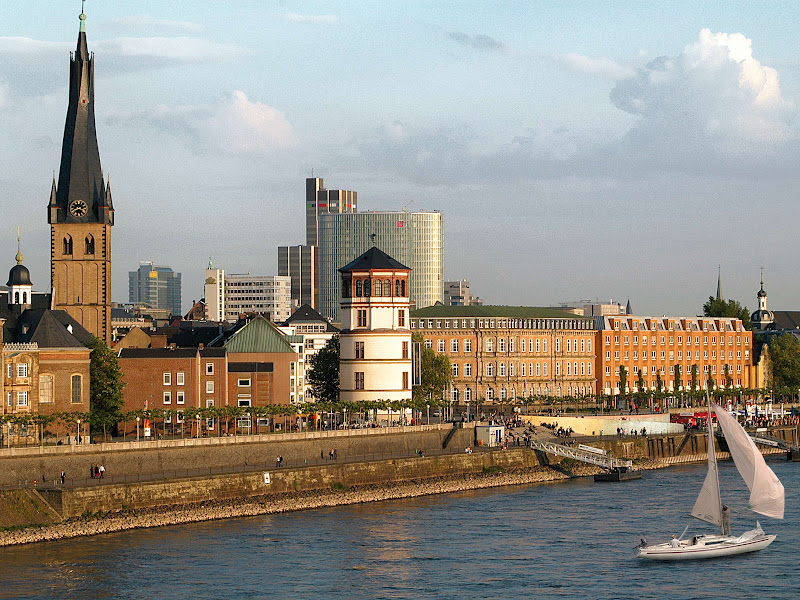
Dusseldorf Germany
It may be a relatively small regional capital, but no one told Dusseldorf’s residents. With an architecture, arts and nightlife scenes that would do much larger cities proud, you’ll get a friendly, small-town vibe together with all the big city tastes of Germany that had you heading half way round the world in the first place. Take the historical Altstadt district, nicknamed ‘the longest bar in the world’, and home to a sleek, vibrant after-dark scene (be sure to try the regional specialty, Altbier) that has it’s own rival in the equally trendy Medeinhafen harbor area just down the road. From traditional, oversized beer halls serving unfeasibly large mugs of lager to glittering cocktail bars, Dusseldorf seems to have everything in terms of nightlife, including freshly cooked Pretzels and street-side Curry Wurst to finish the evening off with.
The ornate buildings of Benrath Palace are Dusseldorf’s postcard attraction, fronted by a lake and huge fountain, and surrounded by expansive gardens, while The Goethe Museum is an ornate baroque building, and a fascinating spot for literature lovers. The Rhine-baroque styles prominent around the Rathaus (town hall) are a big draw, too, as well as the accompanying bronze soldier riding his green-rusting horse.
![]() |
![]() |
Hamburg Germany
Despite being quite obviously inland, Hamburg has a hefty maritime bent to it, with huge hunks of floating iron drifting in and out daily, and rivers interspersing the city-center streets. It's hardly waterworld - in fact Hamburg's notably dated in many places, and all the more attractive for it - but you'll certainly notice the influence of the old sea dog. In amongst it all there’s an entire ‘cultural mile’ to explore, stretching through incredible old buildings, including the exceptional Town Hall, the Kunsthalle (Hamburg’s contemporary art museum), the Museum of Hamburg History and the amazing St. Michaelis Church, with it’s 24-meter-circumference clock faces and striking baroque architecture. Hamburg’s long been a trading town above all else, with the port remaining a key trading spot for Germany, and home to one of Europe’s largest, oldest (and probably smelliest) fish markets. You can explore the expansive harbor on one of the boat tours, which will give you a quick glance at the inner workings of all those huge metal cargo containers and a close up of the mammoth hulls of the ships that float in and out daily.
Cologne Germany
Cologne – or Köln, depending on how native you’ve gone – is Germany’s oldest city, dating back over two centuries. Dominated by the towers of its rustic, soaring cathedral, Cologne is a little heralded corner of Germany that hides numerous photogenic medieval and Roman features amongst its charms. It’s a refined city, a place where Belgian-style chocolate shops integrate the epic beer halls, and the angular pastel houses along the banks of the Rhine give the centre an almost fairytale vibe. It’s hard to miss the twin towers of the 157 meter tall cathedral, Dom, which took over 600 years to build, and are celebrated throughout Germany in songs and literature. Inside you’ll find the golden Sarcophagus of Epiphany, a 13th century relic that’s at the forefront of a mammoth collection of art hidden in the cathedrals’ treasure chamber. In fact, the entire city is rammed full of churches, with twelve ornate Roman examples tucked within the Medieval city walls, including a tiny 9th century worship spot that takes the breath away. The Fish Market, the City Gates, the City Hall, the Praetorium and the Roman Tower all offer outstanding examples of the Cologne of old, too, while you can pick up a thorough explanation of it all at the impressive Römisch-Germanisches Museum, which gives a full account of the Romans along the Rhine, as well as housing its own mosaics.
Thứ Sáu, 19 tháng 10, 2007
Berlin Festival of Lights
Berlin Festival of Lights - bigger and even more fascinating than last year, Berlin Festival of Lights illuminates Berlins famous sights, places and buildings.
Đăng ký:
Bài đăng (Atom)