Thứ Bảy, 4 tháng 8, 2007

Day 2 - Matsuzaka Steak and Yakitori

Day Two (Mon):Shinjuku - Sanrio Puroland (Tama Centre) - Kichijoji - Mitaka no Mori Ghibli Museum - Kichijoji - Shinjuku
Breakfast:Salmon and Mentaiko Onigiri
Purchased at some convenience store in the subway
Lunch:A5 rank Matsuzaka steak at a butcher shop/steak house
Steak House Satou, Kichijoji
Dinner:Yakitori and Shumai at an 80-year-old izakaya
Iseya Honten, Kichijoji


Tama Centre

Our first breakfast in Tokyo followed the tradition of typical Tokyoites -- convenience store Onigiri (rice balls) eaten at a train station. Both the salmon and the mentaiko was quite good at 147 yen each.

This was a day for touring our own childhood. At 8:30AM We took the Keio train to Tama Centre to see the Sanrio Puroland (home of the Hello Kitty, at my wife's request). The tickets (or rather, vouchers for the tickets) were purchased the previous night at a ticket vendor for 2500 yen each, quite a deal compared with 4400 yen at the gate.

The morning commute in the Shinjuku underground was much better than I expected (really nothing compared with the chaotic Admiralty station in Hong Kong). We got to Tama Centre almost AN HOUR early and went for some light shopping.

I'm not going to describe Hello Kitty's home in much detail since there are tons of travel journals doing just that. It's not a huge place, but I can appreciate the attractiveness to Hello Kitty fans. The selection of the licensed merchandises is probably one of the largest in the world. My wife would certainly agree that the three hours of entertainment was more than worth the 2500 yen ticket for her. And for me, the entertainment was watching her eyes light up. Although, the full price of 4400 yen would have been too stiff.

The next stop would complete another THING TO DO BEFORE I DIE. The famed Matsuzaka Beef.


Gourmet Spot #2: A5 Rank Matsuzaka Beef Teppanyaki - Steak House Satou, Kichijoji

Ever heard of Kobe beef? Kobe, Matsuzaka and Oumi are considered to be the three most prestigious cattle-producing regions in Japan. Not that other regions can't produce top quality cattles, but traditionally these three were the more well-known and commanded the top prices.

I can go on and on about Kuroge Wagyu (black-haired Japanese cattle), but the important part is: Japanese beef are typically ranked according to their marbling content and distribution using two systems. At fine steak or shabu shabu restaurants, you would typically find the prestigious A5 ranked Kuroge Wagyu. And A5 Kuroge Wagyu produced in Matsuzaka would usually command very high prices (think 15000+ yen meals). But hey, I said this is a once in a lifetime trip remember?


With some research we ended up getting our top quality Matsuzaka steak at a fraction of the price. There is a place in Kichijoji where the ground floor is a store selling fine meats, including certified Matsuzaka beef. It's difficult to miss it since the lineup for their deep fried minced beef patty (150 yen) is half a block long. And the 2nd floor is a small, slightly cramped restaurant serving the meat sold downstairs. Welcome to Steak House Satou.

DIRECTIONS:

Multiple readers have asked for better directions to this popular restaurant. I hope this is better...

Kichijoji is in the western part of Tokyo. The easiest way is to go to Shinjuku's JR station, and take the "Chuo Line" westbound (towards Takao). It's about 8 stations (if you happen to get on a "Local" train -- less stations if you get on a "Kaisoku" (fast train)), you should get there in about 15 minutes.

Once you get to Kichijoji Station, exit the station from the North Exit. Then follow the map in the following link:
http://gourmet.yahoo.co.jp/0006713464/P001410/coupon/

The crosshair in the map is the location. It's less than 5 minutes walking distance. Not everyone knows about the steak house upstairs, but everyone in Kichijoji knows about the meat shop downstairs. Grab a younger guy and ask about "Satou Nikuya" (Satou meat shop) if you can't find it. If you see a big lineup in front of a meat shop, that's the place.

When you get there, there's a narrow, steep staircase on the right side of the store. That's the entrance to the Steak House. Chances are you'll line up for 30 minutes or more. Good luck!


We arrived way past the typical lunch hour and still ended up in the lineup slowly advancing up the steep stairwell for 30 minutes. It was well spent as we were seated at the counter right in front of the chef. The menu choices were:
Matsuzaka Beef Oil Yaki870 yen
Wagyu steak2500 yen
A bigger Wagyu steak3500 yen
Chef Omakase Set 5000 yen

Remembering the purpose of our trip, we had to order the most expensive set. 180 grams of Chef's select Matsuzaka steak, served with a choice of red, white or Japanese wine. We also ordered the Oil Yaki set, just to see how the cheaper Matsuzaka cuts compares to the steak.
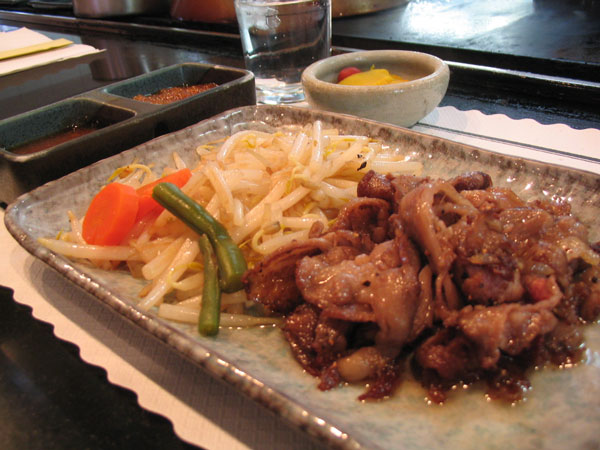


Here comes the Matsuzaka Beef Oil Yaki. Pretty good portion for a measly price. It turned out to be very thin slices of probably bits and pieces of the Matsuzaka cattle. And now the taste...

... was incredible! The slices contained such a balance of meat and fat that the softness and oiliness filled every bite. After a couple bites came the steak we were waiting for.


We actually watched the chef taking this steak (actually two steaks) out of the huge fridge and cut it into cubes as the beef sizzled on the Teppan. I ordered medium rare and waited as the smoky smell of oil and red meat filled the room. I don't know how I managed the patience to finish the salad before taking my first bite of the steak cubes.

Sugoi! So much oil and juice flowed down the tongue even before the bite. And upon the bite, the cube practically disintegrated. Like the cube was composed of many bits and slices of meat and was gently held together by the marbling fat. I can't describe it but it was certainly one of the best meals of my life.
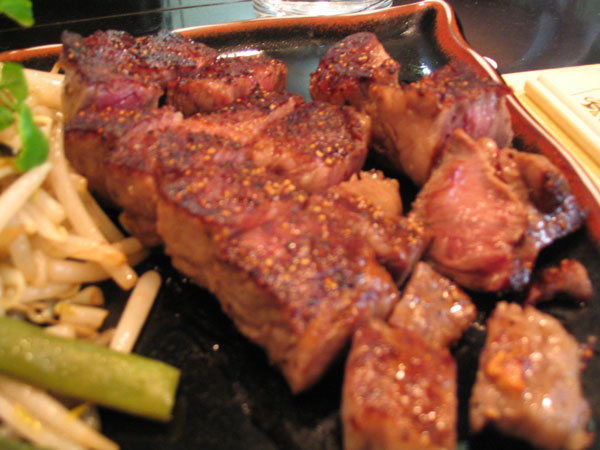


Incredible juiciness and texture. Coupled with the dipping sauce it was heaven.

One last note that the glass of wine, the silky smooth Koshi no Kambai, was quite an excellent match for the texture of the Wagyu. Everything was top quality.

Bill for two persons:
Matsuzaka Beef Oil Yaki870 yen
Chef Omakase Matsuzaka Steak Set5000 yen
(apply tax)
Total6164 yen


Mitaka no Mori Ghibli Museum

What can I say, it's a museum of all things Miyazaki Hayao, complete with a reconstruction of his working studio and a rather complete (and fun) explanation of the animation production process. And for the real Miyazaki fans, a whole library of his complete scene-by-scene sketches from Totoro to Howl's Moving Castle and more. Too bad photos aren't allowed.

There was also a limited time display of Alps no Shojo Heidi, and the short film on display on that day was Kujiratori, a story of elementary school kids' imaginary whale hunt.

How come adults aren't allowed to enter the Neko Bus plush toy?


Gourmet Spot #3: Cheap 80-year-old Yakitori Joint - Iseya Honten, Kichijoji

I've heard about this place a lot over the web, a neighborhood drinking place serving 80 yen (yes, that's correct) yakitori skewers in Kichijoji for generations. That's as Japanese as it gets, I thought, and had to go visit.

And it was worth the trip, as long as cleanliness and seating comfort was no object. Naturally my wife enjoyed the place less than I did, but it was quite a cultural experience. We shared a small wobbly folding table with a young couple, who finished a large bottle of beer and a pile of yakitoris and other dishes and were gone within twenty minutes.


There's a paper menu, but for the large salarymen crowd the menu was right overhead. Notice the smokey fume inside this place. You could smell the yakitori from a block away.
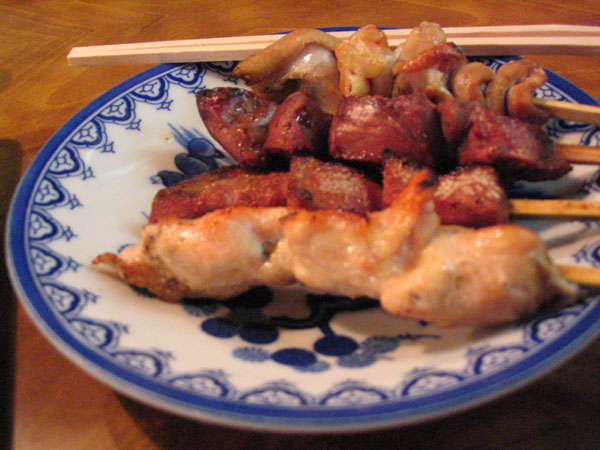


An order of Kushi Mix and 2 draft beers to sample the place. 320 yen for 4 sticks. I think that was one yakitori, one liver, one heart, and one skin. It was worth the 80 yen but not spetacular, especially since I'm not a big fan of medium rare liver. We later ordered a Nankotsu (soft bone), a Tsukune (minced chicken ball), and Gyuutan (beef tongue), and the Tsukune and tongue made up for the lost points.
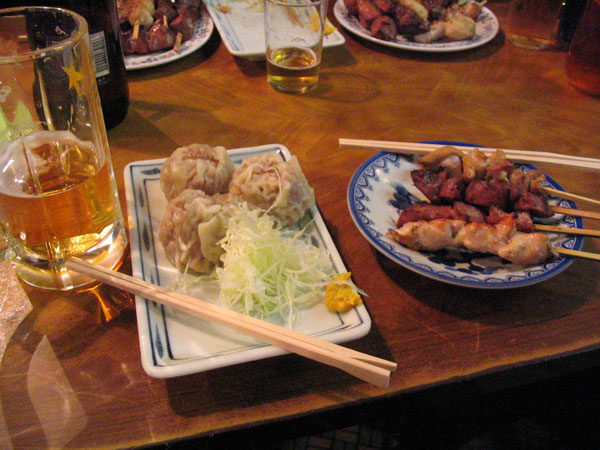


We ordered Shuumai after the young couples. This was easily the best dish. Juicy and very soft in texture, it went very well with the green onion slices. I suddenly realized that a comparison of the Cantonese and Japanese Shuumai sums up the differences between the two cuisines quite nicely.
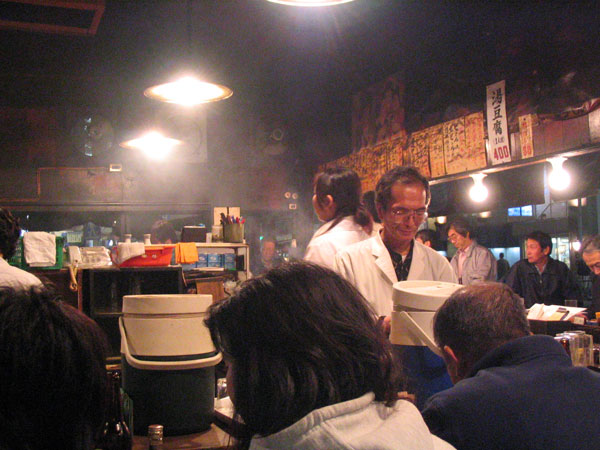


Neighborhood drama time! At this point an older man was standing over a client sitting nearest to the entrance at the counter. A cook (the standing guy in the white coat) came to the older man and a struggle ensued. The cook basically pushed the guy right out of the store amidst a series of yells. Was the older man pestering the client for some free yakitori? All I saw was that the client commended the cook after that man left. That in itself had that made the visit worthwhile.

Bill for two persons:
Nama Biiru x 2900 yen
Kushi Mix320 yen
Nankotsu, Tsukune, Gyuutan240 yen
Shuumai330 yen
(apply tax)
Total1880 yen

Day 1 - Poisonous Fugu

Day One (Sun):Narita Airport - Nippori - Shinjuku
Lunch:On the plane
Dinner:Fugu course at a specialist restaurant

Torafukutei (not the TorafuGUtei chain), Shinjuku


Narita Airport

Yahoo Japan's weather prediction lied! It was supposed to be a day of sun and clouds, but our plane descended towards a wet and dark Narita. And it's only 2:15PM!

The first impression of Narita from the sky is...how come there's so much farmland and green fields..I thought it's a suburb of Tokyo. (I realized later that it's in the next prefecture.)

An old officer was directing the traffic (Japan passport holders to the left side, Gaijin to the right) at the entrance to the immigration lineup for foreigners and speaking something to us (in Japanese of course) as we walked by. Hmm...I think he probably knew that most people in the lineup won't understand what he said.

Now how do I buy a regular (the cheapest fare) Keisei ticket to Shinjuku? I wasn't sure if the ticket counter spoke any English and so I started punching the buttons on a ticket vending machine. The buttons had names of some of the platforms on it, but somehow I thought the calculation was backwards. So I ended up going to the ticket counter.

The guy spoke English! Well, two word sentences, but better than my Japanese anyway. Two tickets to Nippori. Onegaishimasu. Hai? 4000 yen? Uh no, the cheaper ticket... Okay 2 tickets to Nippori for 2000 yen. That's not too bad.

We hopped on a Tokkyu (express, ie. skipping smaller stations) train towards Tokyo on the Keisei line and spent most of the 80 minutes watching the ornate house roofs and our fellow passengers...why are high school kids dressed in school uniform on a Sunday? The 1000 yen ticket got us to Nippori but now we've got to hop on the JR Yamanote line to Shinjuku. Ticket window time again. Okay Japanese 101 here we go.

Me: Shinjuku ni. (presenting our two Keisei tickets)
Attendant: Sambyaku hachiju en

Sugoi! My first conversation in Japanese in years lasted two words. And we got tickets to Shinjuku!

Shinjuku

The Yamanote was only slightly crowded, as it was a dark and rainy late afternoon on a Sunday. The next hour after arriving at Shinjuku came a big test of navigation and speed -- I had to pickup reservation of my Odakyu Romance Car tickets before it closes at 6PM, AND get two Sanrio Puroland tickets from the ticket vendors outside of Shinjuku Nishiguchi before they close at 7PM. All that in a totally foreign landscape of convoluted but interconnected paths. And pouring rain. And I had to leave my wife to guard the luggage. It was not fun. Even the two Tokyoites I asked (my Japanese miraculously came alive..don't ask me how) didn't know where the Odakyu ticket centre for Gaijin was (I went to the Odakyu ticket centre for locals but my reservation wasn't inside their system). Somehow I found a small English sign and found the ticket centre exactly at 6PM.

To get to the hotel in pouring rain we decided to take the bus, which I knew was called Shintoshin Junkansen (new city centre roundtrip). We jaywalked (with luggage and all) to the big bus loop only to find out that our bus only stops where we originally came out of the subway. Orz...

So we dropped off our luggage at Shinjuku Washington (checking in was smooth...the frontdesk spoke fluent English) and headed to our first real tour spot -- the FUGU restaurant.

Gourmet Spot #1: The Poisonous Fugu -
Torafukutei, Shinjuku
[UPDATE July 2008: The Shinjuku branch's site is down and it may have closed its doors. If interested, please check out the Ikebukuro branch.]

This is fugu (pufferfish).

Its legendary status is in part due to the fact that its liver and ovaries contain enough poison to kill many adults, and there is no antidote once you discover the main symptom of lip and tongue numbing. People die every year, but the unique sweetness of the meat still draws millions of fans. And we were about to add to the fan list.

The restaurant was called Torafukutei, not to be confused with the TorafuGUtei chain. I chose this place because the dinner courses were very reasonably priced for a fugu restaurant, where 10000+ yen courses are quite normal. After all, you live or die depending on the skill of the chef.

We were given a private room of traditional dark wood decor with lantern lighting. The waitress spoke some English, "This is fish. And beef hotpot," as she pointed to the 5000-yen-upwards courses. I think she was very surprised when we ordered one 3000 yen and one 4000 yen course AND THEN produced a 10%-off-coupon from Hotpepper.
[UPDATE July 2008: Coupon no longer available online -- pick up a printed copy of Hotpepper lying around subway stations maybe.]


The first course was Fugu Kawa Yubiki -- a boiled fugu skin salad with ponzu and red pepper. Like most fish skin it was quite chewy, but had to depend on the sauce to bring out its flavor.


We ordered a cup of hirezake (wine infused with fugu fin). The waitress lighted up the fugu fin and covered the cup to infuse the flavor of the flame broiled fin. Very intensely fragrant. It's said to get people drunk easily, but didn't fell a light drinker like me.


Here comes my favorite dish of this meal. For a 3000-4000 yen meal We expected about 6-8 slices of Tessa (fugu sashimi), but we got 20 per person! I'm not sure how Tessa was supposed to taste (at 3000 yen it surely wasn't wild fugu), but the sweetness of the meat was very noticeable and distinct. Not the mirugai kind of sweetness, but a more subtle *umami* taste. And the chewiness of the meat brought me to keep chewing and tasting the meat for a long time.


Then a waiter brought the stove for our Sumiyaki Fugu (charcoal broiled). Note the two sauces. I liked the darker sauce the best, but I had no idea what it was (Aka Miso + Mirin?).


And this is how the broiled fugu looked like. We joked about how similar the texture was to chicken breast, except the taste was of a sweet and *very* fresh fish.


Then came the big Tecchiri, which was a hotpot of fugu chunks (with bones) and vegetables. By now all of the fish except for the head and the internal organs were used in this meal (just count...skin, fillet, fin, meat and bones).


Another waitress came and prepared the last dish for us. She was surprised when I asked to take a picture...Watashi mo?...and then giggled and posed. The dish consisted of mixing cooked rice and eggs to the remaining soup in the hotpot.


Last but not least, the Zosui. It seemed that the the entire sweetness of the fish went into the broth. It was incredibly *umami* for a fish broth.

I did get a little diarrhea symptom right after the meal...food poisoning? The scary thought crossed my mind for an quick instant, and then my reasoning told me that fugu poisoning wasn't like that!

Daimanzoku! Crossing off one item on my list of THINGS TO DO BEFORE I DIE. (This would sound much more ominous before the meal.)

Food Bill for 2 persons:
Yaki Fugu Set3129 yen
Tecchiri Set4179 yen
Hirezake735 yen
(apply -10% coupon and 5% service charge)
Total~7600 yen

Tokyo Food Trip - Overview

Tokyo and Greater Kanto: Eight Day Self-Guided Gourmet Tour

Well, as you can guess from the title. I must admit that the main motivation behind this whole trip was the prospect of sampling a large variety (and amount) of Japanese cuisine I'll have no chance of finding anywhere else. There were the legends of steaks that melt in the mouth or poisonous fish that offers the remote (but real) chance of an agonizing slow death. And there were the photos of the seemingly endless rows of brightly-lit drink vending machines, and street side carts of charcoal-barbecued chicken surrounded by huddled salarymen. As a huge fan of Japanese culture, the allure was just so great.

Quality vs Cost

So after persuading my wife we took more than six months to carefully plan out our trip to Japan. The point here is "Once In A Lifetime." We're a young couple and money is tight for us. Considering that we do not plan to travel to Japan frequently (accomodation isn't cheap, and neither is a Vancouver flight to Tokyo for two), we want to make the most of our time and money spent in Japan and leave no regrets of must-see places unvisited or must-try cuisines untried (although...if I only had once more day...). And the point isn't about going to the most acclaimed (and expensive) restaurants (although I did seriously think about planning a meal at Iron Chef Nakamura's restaurant at Ariake). A cheap and simple meal may offer an experience of a lifetime (check out our Day 3 meal at the Ramen Kokugikan in Odaiba). Again, the point is "Once In A Lifetime." And no regrets as we look back.

Why Tokyo?

Why did we choose Tokyo? Actually, I originally planned to go Kansai since I wanted to experience Kyoto, but my wife reminded me that it was to be our first trip to Japan. And Tokyo (apologies to all Osaka-lovers) is simply one of the great metropolis of the world and I realized I would deeply regret if I missed the chance to see Tokyo. The fact that it's easy to find cuisines of all Japanese localities within Tokyo (let's see, we had Hokkaido uni, Hiroshima oysters, Kyoto-style kaiseki...) made it an easy decision.

Pre-Trip Planning

As mentioned above I took many months of planning and research, mostly done on the Internet. I learned two years of Japanese in junior highschool, but somehow still couldn't read all the katakanas and had no real chance of speaking or reading any Japanese for the past twelve years. Researching itinerary and restaurants on the Internet became a great way for me to re-learn my vocabularies and practice my reading. With my knowlegde of written Chinese I knew most of the Kanji already, so it was a kana and grammar exercise. Browsing restaurant guides such as Gurunabi and Hotpepper became my daily habit. Although I got to admit, my speaking and listening ability remained at the single-word-phrase level before the trip.

We had the local travel agency booking two 3-consecutive-night stays at the Shinjuku Washington Hotel for us with one unbooked night in the middle, allowing us to take a sidetrip to Hakone (which was the most excellent idea...check out Day 4). The entire itinerary is listed at the Quick Navigation Guide.

Planning Strategy

The main strategy in planning the itinerary was to identify the particular varieties of cuisine we wanted and finding the corresponding specialty restaurants with good rating and/or a lot of history. Then we arrange these restaurant visits around our sightseeing spots and shuffled the sightseeing times such that the restaurant visits always occured at lunch and dinner time. Kind of backwards isn't it? Well, it was a gourmet trip after all so that's how it went.

And one more thing. At most upscale restaurants in Tokyo, a particular meal at lunch is most likely way cheaper than the same meal at dinner. The dinner portion may be a little bigger and/or contain a little more variety and/or aesthetical arrangement. But I assure you the lunch portion would more than fill up an average adult. (I don't know who propagated that idea that Japanese meals are small in portion...that's quite far from the truth in Tokyo.) There are some varieties of food which are difficult to find for lunch (fugu/pufferfish comes to mind), but otherwise consider our strategy: Save the expensive Kaiseki course and Matsuzaka steak for lunch, and have cheap yakitori and ramen for dinner!

This travel journal here mainly presents what I saw and experienced during the trip, and may not be helpful at all as a guide. If you have any particular question, email me and I'll try my best.

Alright, Kanto here we go...

Canada - Logger Sports World Championship


Living in Canada I've seen a fair share of odd and quirky competitions (Nanaimo's Bathtub Racing comes to mind). So when I headed for Squamish today for the 50th anniversary of the Logger Sports Festival, I was expecting another comical exhibition of so-called "sports" nobody else in the world cared about. Well...

To most tourists starting out from Vancouver, the little logging town of Squamish is only a short stop on the way to Whistler. Squamish is a reputed destination for wind-surfers, rock-climbers and birding enthusiasts, but for the thousands who chose to visit on this particular weekend, the main draw was the Squamish Days Logger Sports competition -- a world championship for a group of bizarre and mostly dangerous sports involving huge logs and sharp axes.

How dangerous? How about climbing 80-feet to the top of a huge log in 15 seconds and then racing down in a series of 15-feet jumps, using nothing more than a piece of rope and spiked boots? Yes, this is a lady in case you're wondering. Men and women competed side-by-side.


If the prospect of falling to death isn't exciting enough, there's always the axe-throwing competition. Five points for the bull's eye, then four, three, two and one. This kid here was only 12, and won 2nd place in the Intermediate class against the grown men and women.


If big is beautiful, then these huge saws in the Double Hand Bucking event were the best of the day. Strength and teamwork were of utmost importance here.


Now this was a strange but historically important logger skill. Before the arrival of mechanical logging, a logger would cut little notches in the trees for insertion of springboards, on which he would then stand and cut down the top part of the tree. Nowadays this skill can hardly be seen outside of competitions.


This Obstacle Pole Chop event was somewhat of a balancing act -- except the object of balancing was the chainsaw-wielding logger himself.


As you can see the ladies competed alongside the men. Here the lady got the upper hand.


This lady didn't fare so well though and finished last, but did finish the grueling event with the crowd cheering and rallying behind her.


Now this is the event where ladies dominated -- the crowd favorite event of log rolling. The competitors kept the feet moving and tried to roll each other into the water first. Tremendous balance was on display here -- I'm sure I would have fallen off the log in two seconds even on dry land.


After the show we drove to the Squamish Spit, a famous wind-surfing and kite-surfing spot at the mouth of the estuary. The scenery was breathtaking, but what you can't see in the photo was the unbelievably fierce wind howling behind our backs. The view of the lush green estuary was worth it though.


But it is that fierce wind that makes the place a wind-sport paradise. I certainly would love to learn to kite-surf in such a beautiful environment. The big vertical rock face in the background is the Stawamus Chief, a world-class rock-climbing destination.


You can catch quite a spectacular show just standing on the sideline. I'm having a lot more respect for the kite-surfing sport after watching some of the acrobatic moves these atheletes could pull off.


We didn't stay for too long though as it was just too windy and cool even on a sunny August day. The hour-long scenic drive back to Vancouver was beautiful, even with all the highway construction going on for the 2010 Winter Olympics.